
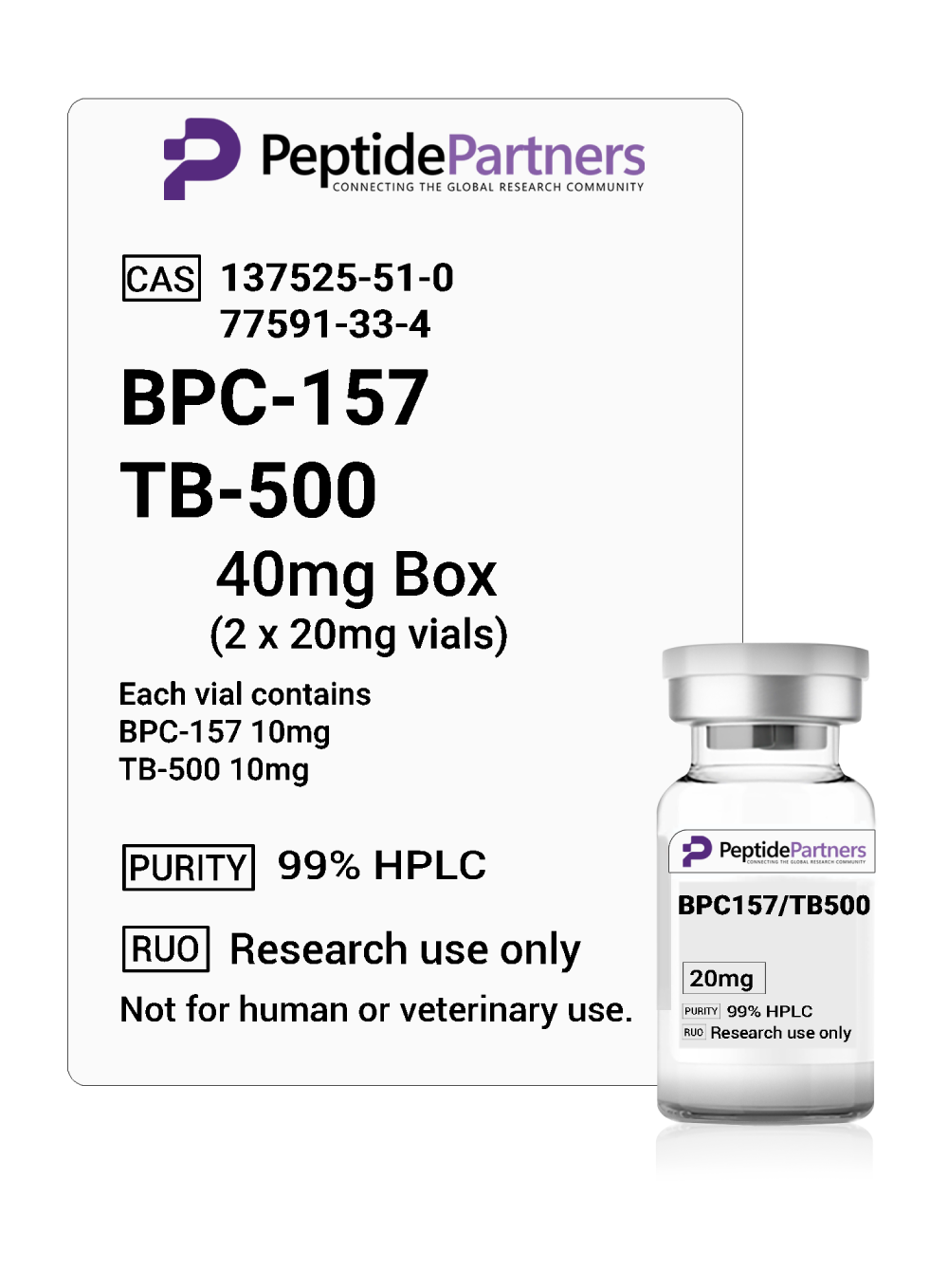
Combo Vial: BPC-157/TB-500 Kit
Price range: $234.00 through $796.00
Description
Combo Vial: BPC-157/TB-500 Kit
Save over 55%!
Swipe right to view full table →
 |
Peptide Sciences | Liberty Peptides | |
Cost per milligram |
$3.98 – 5.85 |
$12 | $10.40 |
Purity |
99.52% |
98.9% | UNK |
Certified Endotoxin-safe |
Yes |
No | No |
Independently Tested |
Yes |
No | No |
Peptide Partners Manufacturer Id: SH07
Batch Id: BB20250630
Overview
(For educational purposes only)
TB-500 has emerged as a significant peptide of interest in regenerative medicine, representing a synthetic version of the naturally occurring protein Thymosin Beta-4. This 43-amino acid peptide functions as a potent regulator of cellular actin, facilitating tissue repair through multiple complementary mechanisms. Research suggests its therapeutic potential spans multiple body systems, with particular efficacy in promoting wound healing, supporting muscle recovery, and potentially facilitating recovery from various types of tissue injury. While extensive animal studies have demonstrated promising results, human research remains in early phases, and the peptide’s regulatory status places it primarily in the research domain.
Molecular Structure and Natural Origins
TB-500 is a synthetic representation of Thymosin Beta-4 (Tβ4), a naturally occurring peptide widely distributed throughout the body’s tissues and cells. This 43-amino acid peptide belongs to a conserved family of 16 related molecules that share significant sequence homology and are found in most tissues and circulating cells.
Endogenous Production and Distribution
Thymosin Beta-4 is naturally present in various tissues and fluids throughout the body:
· Found in high concentrations in blood platelets and wound fluid[1]
· Released by various cell types, including platelets and macrophages[2]
· Ubiquitously expressed across virtually all human and animal cells[3]
· Naturally upregulated in areas of tissue damage[4]
The gene encoding Thymosin Beta-4 is among the first to be upregulated following tissue injury, highlighting its essential role in the body’s immediate response to damage[1]. This rapid induction suggests Thymosin Beta-4 serves as an early mediator in the complex cascade of healing processes.
Synthetic Development
The synthetic version, TB-500, was developed to harness these regenerative properties in a more concentrated and stable form. While the complete natural peptide consists of 43 amino acids, research has identified that a specific fragment—the N-terminal acetylated 17-23 fragment (Ac-LKKTETQ)—represents the active component that confers many of the therapeutic benefits[5].
Mechanism of Action
The therapeutic effects of TB-500 stem from multiple complementary mechanisms that collectively enhance tissue repair and regeneration.
Actin Regulation
The primary mechanism through which TB-500 exerts its effects involves interaction with actin, a fundamental cellular protein:
· Functions primarily as an actin-binding protein, forming a ternary complex with actin and profilin[2][6]
· Regulates actin polymerization, a critical process for cellular structure and function[7]
· Affects actin, which comprises up to 10% of total cell proteins and plays a major role in cellular genetic makeup[3]
· Up-regulates actin production, enhancing cellular structure and mobility[8][4]
This actin-modulating function is central to TB-500’s effects, as actin forms microfilaments that are vital for cell shape, membrane integrity, movement, and certain steps in cellular reproduction[2].
Cell Migration and Proliferation
TB-500 significantly enhances cellular mobility and reproduction:
· Promotes cell migration through specific interactions with the cellular cytoskeleton[3]
· Accelerates migration of endothelial cells and keratinocytes[3][6]
· Stimulates stem cell migration and proliferation[6]
· Attracts myocyte and myoblast cells to wound locations, critical for tissue repair[6]
· Enhances differentiation of stem/progenitor cells to form new tissues[2]
Angiogenesis and Tissue Regeneration
The peptide demonstrates remarkable ability to support new blood vessel formation:
· Identified as a gene up-regulated four-to-six fold during early blood vessel formation[3]
· Promotes the growth of new blood cells from existing vessels[3][8]
· Creates new blood vessels through stem cell regulation[6]
· Enhances regeneration of blood vessels, supporting cardiovascular applications[8]
Anti-Inflammatory Activity
TB-500 exhibits potent anti-inflammatory properties that complement its regenerative functions:
· Functions as a potent anti-inflammatory agent[4]
· Modulates inflammatory response to injury[6]
· Reduces inflammation at wound sites[2]
· Decreases scar formation and fibrosis by reducing myofibroblasts in wounds[2]
These multiple mechanisms work synergistically to enhance the body’s natural healing processes, explaining both TB-500’s high regenerative efficacy and its comprehensive effects across different tissue types.
Therapeutic Applications and Research Evidence
Research suggests TB-500 has potential applications across multiple body systems and conditions, though most evidence comes from preclinical studies.
Wound Healing and Tissue Repair
TB-500 demonstrates significant efficacy in promoting wound healing and general tissue repair:
· Promotes healing in tendons, ligaments, muscle, skin, heart, and eyes[4]
· Increases cells in healing processes and improves cell migration to injury sites[4]
· Reduces scar tissue formation[4][2]
· Enhances wound healing through improved cellular migration[8]
· When administered subcutaneously, promotes wound healing and muscle recovery[3]
The peptide’s wound-healing properties differ from traditional growth factors in that it specifically promotes endothelial and keratinocyte migration, does not bind to extracellular matrix, and can travel relatively long distances through tissues due to its low molecular weight[3].
Musculoskeletal Applications
TB-500 shows particular promise for musculoskeletal conditions:
· Supports muscle building and speeds recovery time of muscle fibers and cells[3]
· Facilitates soft tissue repair in sports and athletic injuries affecting tendons, ligaments, and muscles[4]
· Enlarges muscle growth, muscle tone, and muscular stamina[4]
· Encourages bone remodeling and growth after fracture[7]
These properties make TB-500 of particular interest in sports medicine and rehabilitation contexts.
Cardiovascular Applications
Emerging research suggests potential cardiovascular benefits:
· Being investigated for systemic treatment of patients with ST-elevation myocardial infarction (STEMI)[1]
· May prevent or repair continued damage to cardiac tissue post-heart attack[1]
· Supports mending of heart muscle following myocardial infarction[7]
· Phase I safety studies for cardiovascular applications showed no dose-limiting or serious adverse events[1]
Neurological Applications
Recent studies indicate possible neurological benefits:
· New data suggests potential for improved neurological outcomes after stroke or brain injury in animal models[7]
· In rat models of spinal cord injury, treatment with Tβ4 significantly improved locomotor recovery[2]
· Increased numbers of surviving neurons and oligodendrocytes and reduced inflammation in spinal cord injury models[2]
· Demonstrated neuroprotective, anti-inflammatory, and vasculoprotective properties in neurological applications[2]
Other Potential Applications
Additional areas of investigation include:
· May improve hair regrowth in areas of injury[4][8]
· Shows potential for restoring retinal (eye) tissue[7]
· Reduces microbial growth after injury[2]
Safety Profile
Available evidence suggests TB-500 has a generally favorable safety profile, though human data remains limited:
· Phase I safety studies showed no dose-limiting or serious adverse events throughout the dosing period[1]
· Safety profile is supported by its derivation from naturally occurring substances in the body[8]
· Like other peptides derived from endogenous substances, it appears to enhance the body’s natural healing processes rather than introducing novel mechanisms[6]
However, it’s important to note that comprehensive human safety data remains limited, particularly regarding long-term use or potential interactions. Research continues to assess its safety and efficacy across different dosages and application methods[8].
Current Regulatory Status
TB-500’s regulatory status is primarily as a research compound:
· Available on the internet and officially distributed as a research peptide[5]
· Has gained attention from anti-doping agencies, with the World Anti-Doping Agency (WADA) investigating its metabolism and detection methods[5]
· Detection methods have been developed for TB-500 and several metabolites in horse urine and plasma, with ongoing work on human detection methods[5]
· Reference standards have been synthesized and distributed to doping control laboratories[5]
It’s worth noting that TB-500 is not currently approved by regulatory agencies like the FDA for human therapeutic use, and its availability is primarily in the research domain.
Conclusion
TB-500 represents a fascinating peptide with significant therapeutic potential across multiple body systems. As a synthetic version of the naturally occurring Thymosin Beta-4, it works primarily by regulating actin—a fundamental cellular protein—to enhance cell migration, tissue regeneration, angiogenesis, and anti-inflammatory processes.
Preclinical and limited clinical research suggest promising applications in wound healing, musculoskeletal repair, cardiovascular recovery, and even neurological rehabilitation. The peptide appears to enhance the body’s intrinsic healing mechanisms rather than introducing novel pathways, which may contribute to its favorable preliminary safety profile.
However, despite its potential, TB-500 remains primarily in the research domain, with comprehensive human clinical trials still in early phases. As research continues, our understanding of TB-500’s full therapeutic potential and safety profile will likely expand, potentially opening new avenues for regenerative medicine approaches to various injuries and conditions.
Further investigation, particularly through well-designed human clinical trials, will be essential to fully characterize TB-500’s efficacy, optimal dosing, and comprehensive safety profile before its potential therapeutic applications can be fully realized in clinical practice.
⁂
1. https://www.peptidesciences.com/peptide-research/tb-500-thymosin-beta-4
2. https://particlepeptides.com/en/buy-peptides/20-thymosin-beta-4-tb-500-10mg.html
3. https://particlepeptides.com/en/content/28-thymosine-beta-4-tb500
4. https://focalpointvitality.com/thymosin-beta-4-peptide/
5. https://www.wada-ama.org/en/resources/scientific-research/investigation-vitroex-vivo-tb-500-metabolism-synthesis-relevant
6. https://tb-500.com/blogs/articles/how-tb-500-works
7. https://timesofindia.indiatimes.com/science/unlocking-the-potential-of-tb-500-possibilities-in-tendon-and-tissue-repair/articleshow/107628524.cms
Additional information
| Quantity (mg) | 40mg, 100mg, 200mg |
|---|
Related products
-
BPC-157 Kit (20mg – 200mg)
Price range: $96.00 through $720.00 Select options This product has multiple variants. The options may be chosen on the product page -
BPC-157 Kit
$200.00 Select options This product has multiple variants. The options may be chosen on the product page -
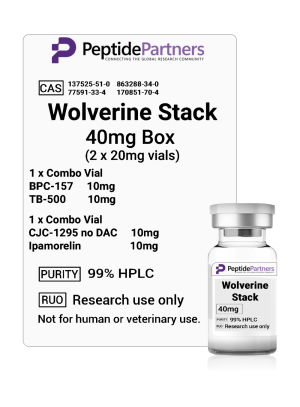
Wolverine Stack (BPC/TB5, CJC/IPA)
Price range: $212.00 through $636.00 Select options This product has multiple variants. The options may be chosen on the product page -

TB-500 (TB4) Kit (20mg – 100mg)
Price range: $103.00 through $420.00 Select options This product has multiple variants. The options may be chosen on the product page

Reviews
There are no reviews yet.