
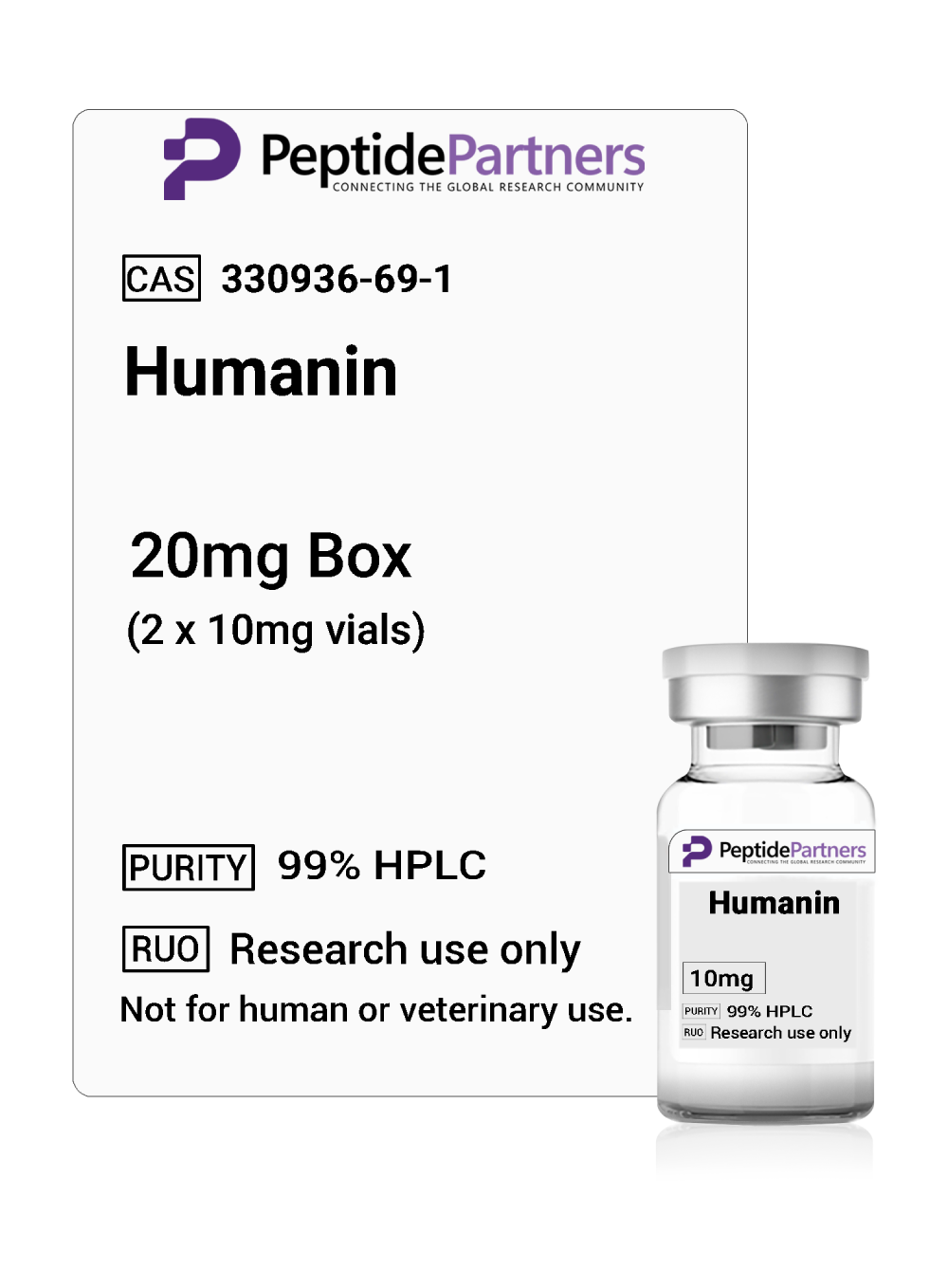
Humanin (20mg – 100mg)
Price range: $150.00 through $660.00
Description
Humanin
Save over 60%!
Swipe right to view full table →
 |
Peptide Sciences | Core Peptides | |
Cost per milligram |
$6.6 – $7.5 |
$15.50 | $14.70 |
Purity |
99.92% |
98.6% | 95.1% |
Certified Endotoxin-safe |
Yes |
No | No |
Independently Tested |
Yes |
No | No |
Peptide Partners Manufacturer Id: WF03
Batch Id: HP20250805
Overview
(For educational purposes only)
Humanin is a highly conserved, mitochondria-derived peptide (MDP) that has attracted considerable attention for its remarkable cytoprotective properties and potential roles in aging, neurodegeneration, and metabolic disorders. First described in 2001 through screening of Alzheimer’s disease (AD) brain cDNA libraries, humanin is now recognized as a critical signaling peptide encoded within the 16S rRNA gene (MT-RNR2) of the mitochondrial genome.[1][2][3]
Molecular Identity and Structure
Humanin is a short peptide of 21 (mitochondrial) or 24 (cytoplasmic) amino acids (sequence: Met-Ala-Pro-Arg-Gly-Phe-Ser-Cys-Leu-Leu-Leu-Leu-Thr-Ser-Glu-Ile-Asp-Leu-Pro-Val-Lys-Arg-Arg-Ala). Its secondary structure features a three-turn α-helix without symmetry. The humanin gene is encoded in the mitochondrial DNA, but several nuclear-encoded, humanin-like paralogs (MTRNR2L1-13) have been identified, though it is unclear which are actively translated in vivo. Humanin is also one of the most evolutionarily conserved mitochondrial peptides, with functional analogs found in nematodes and rodents.[2][4][5][1]
Mechanisms of Action
Humanin exerts its biological activity through both intracellular and extracellular mechanisms:
-
Intracellularly: Humanin binds to pro-apoptotic proteins such as BAX, Bim, and tBid, as well as insulin-like growth factor binding protein-3 (IGFBP3), inhibiting their activity and preventing caspase activation and apoptosis.[6][1]
-
Extracellularly: Humanin interacts with the formyl peptide receptor-like 1 and 2 (FPRL1/2) and the trimeric receptor complex CNTFR-α/gp130/WSX-1, triggering signaling cascades including JAK2/STAT3 and PI3K/AKT pathways, enhancing cell survival and mitochondrial biogenesis.[7][1][6]
-
Cytoprotective Functions: Humanin protects cells against multiple types of stress, including oxidative stress, β-amyloid toxicity, and apoptosis, and is broadly cytoprotective for neurons, cardiac myocytes, endothelial cells, and more.[3][4][8]
Physiological and Pathophysiological Roles
Neuroprotection and Neurodegeneration
Humanin was first identified based on its ability to protect neurons from amyloid-beta (Aβ) toxicity and familial AD gene products. It has since been shown to protect hippocampal and cortical neurons from various insults, with neuroprotective effects observed in multiple AD and Parkinson’s disease models. Data suggest that humanin can improve cognitive performance, reduce plaque burden, and promote cell survival in neurodegenerative disorders.[9][3][7][6]
Metabolism and Insulin Sensitivity
Humanin improves systemic insulin sensitivity, promotes glucose metabolism, and may protect against diabetes-related β-cell apoptosis. Animal and human studies suggest that higher circulating humanin levels are associated with increased longevity and improved healthspan.[5][10][11][6]
Cardiovascular Protection
Humanin modulates vascular function, reduces endothelial dysfunction, and limits myocardial ischemia-reperfusion injury, suggesting potential in protecting heart tissue during cardiovascular events.[12][4]
Reproductive, Gonadal, and Other Systems
Humanin has been found in gonadal tissues and may regulate reproductive cell survival. There is emerging evidence for HN’s regulation of bone cells and involvement in tissue regeneration.[1]
Aging, Longevity, and Healthspan
Studies demonstrate that humanin concentrations decline with age in both mice and humans. Animal models with higher humanin levels exhibit improved healthspan and lifespan, while overexpression of humanin in C. elegans increases autophagy and extends lifespan. Humanin may act as a mitochondrial–cytosolic stress signal with systemic, hormone-like effects.[10][13][6][5]
Potential Clinical and Therapeutic Applications
Experimental and translational studies suggest that humanin or its analogs may be beneficial in:
-
Alzheimer’s disease and other neurodegenerative disorders (via neuroprotection and anti-apoptosis)[3][9]
-
Type 2 diabetes and metabolic syndrome (through improved insulin sensitivity and cell survival)[11]
-
Cardiovascular disease (through mitochondrial protection and endothelial function)[12]
-
Mitochondrial and age-related disease (as cytoprotective and longevity-promoting factors)[13][5][10]
-
Parkinson’s disease (via neuroprotection and mitochondrial biogenesis)[7]
Intranasal or parenteral administration of synthetic humanin has shown efficacy in animal models for neuroprotection, cardiac protection, and against metabolic stress.[11][7]
Key Biochemical and Identification Data
-
Amino Acid Sequence: Met-Ala-Pro-Arg-Gly-Phe-Ser-Cys-Leu-Leu-Leu-Leu-Thr-Ser-Glu-Ile-Asp-Leu-Pro-Val-Lys-Arg-Arg-Ala (24 aa; cytoplasmic form)[4]
-
Gene: Encoded by mitochondrial MT-RNR2 (16S rRNA)
-
Molecular Formula: C112H174N32O38S (24 aa form)
-
Molecular Weight: ~2,691 Da (24 aa form)
-
Discovery Year: 2001[3]
-
Broad Category: Mitochondrial-Derived Peptide (MDP), cytoprotective/neuroprotective factor
-
PubChem CID (synthetic forms): Multiple (varies with analog), see UniProt Q8IVG9[14]
Safety and Limitations
Humanin and its analogs are considered safe in animal studies; however, human studies are limited. Because humanin influences numerous apoptosis-related and growth factor pathways, long-term risks and potential impact on tumor biology remain areas of active investigation.[15][11]
Conclusion
Humanin is one of the first characterized mitochondrial-derived peptides and is notable for its potent cytoprotective, neuroprotective, and anti-aging functions. Experimental and translational data strongly support its role as both an intracellular stress responder and extracellular signaling molecule. Ongoing research is focused on developing humanin analogs and delivery strategies for a range of age-related and degenerative diseases, as well as clarifying its full range of physiological effects and safety profile in humans.[5][13][9]
⁂
-
https://www.sciencedirect.com/science/article/pii/S001429992500264X
-
https://www.alzdiscovery.org/uploads/cognitive_vitality_media/Humanin-and-humanin-analogs.pdf
-
https://www.sciencedirect.com/science/article/pii/S1875213620301406
-
https://www.sciencedirect.com/science/article/pii/S1043276013000179
Additional information
| Quantity (mg) | 20mg, 50mg, 100mg |
|---|
Related products
-
Reconstitution Solution (BAC) (20mL – 100mL)
Price range: $28.00 through $120.00 Select options This product has multiple variants. The options may be chosen on the product page -
CJC-1295 no DAC (20mg – 200mg)
Price range: $98.00 through $760.00 Select options This product has multiple variants. The options may be chosen on the product page -
Semaglutide Kit (50mg – 200mg)
Price range: $249.00 through $784.00 Select options This product has multiple variants. The options may be chosen on the product page -

Oxytocin Acetate
$180.00 Select options This product has multiple variants. The options may be chosen on the product page

Reviews
There are no reviews yet.