
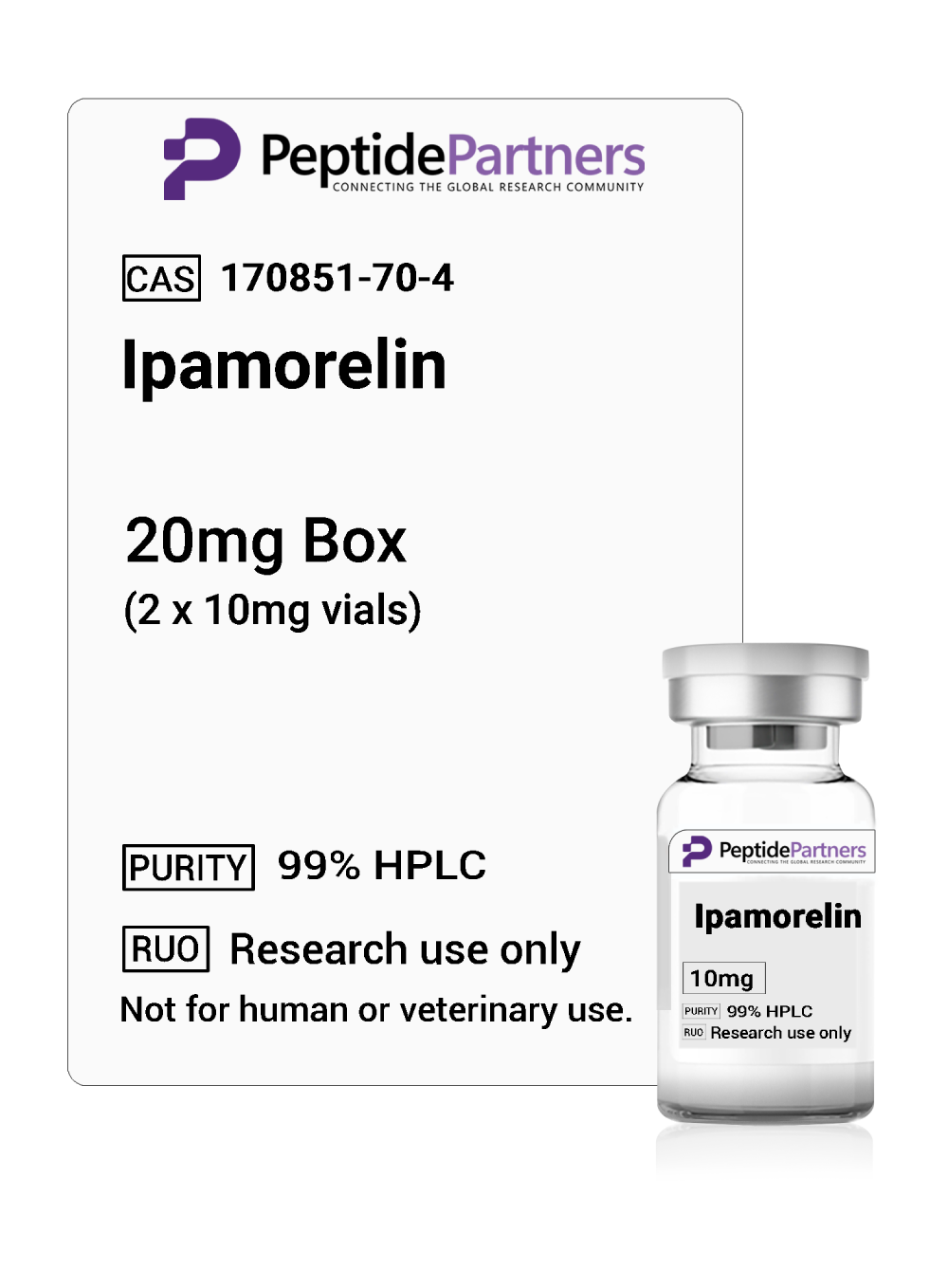
Ipamorelin (20mg – 200mg)
Price range: $68.00 through $480.00
Description
Ipamorelin Kit
Save over 70%!
Swipe right to view full table →
 |
Peptide Sciences | Liberty Peptides | |
Cost per milligram |
$2.40 – $3.40 |
$8.00 | $7.60 |
Purity |
99.6% |
99.8% | 99.9% |
Certified Endotoxin-safe |
Yes |
No | No |
Independently Tested |
Yes |
No | No |
Peptide Partners Manufacturer Id: WF03
Batch Id: IP20250721
Overview
(For educational purposes only)
Ipamorelin represents a significant advancement in peptide therapeutics as a highly selective growth hormone secretagogue with unique properties that distinguish it from similar compounds. This synthetic pentapeptide stimulates growth hormone release while demonstrating remarkable selectivity compared to other peptides in its class. With potential applications ranging from muscle growth to metabolic regulation, Ipamorelin has attracted interest in both clinical and performance enhancement contexts, though its regulatory status varies globally.
Molecular Structure and Classification
Ipamorelin belongs to the family of growth hormone releasing peptides (GHRPs) and functions as a selective agonist of the ghrelin/growth hormone secretagogue receptor.
Chemical Composition
Ipamorelin possesses a distinct molecular structure that contributes to its specific activity profile:
· A pentapeptide with the amino acid sequence Aib-His-D-2-Nal-D-Phe-Lys-NH₂[1][2]
· Derived from GHRP-1 but with structural modifications[1][2]
· Molecular mass of 711.85 Daltons[2]
· Molecular formula of C₃₈H₄₉N₉O₅[2]
· Contains non-standard amino acids including D-2-Nal (D-2-naphthylalanine) and Aib (aminoisobutyric acid)
This specific amino acid sequence provides Ipamorelin with both potency and selectivity in its interactions with the ghrelin receptor system. Its development code name during research phases was NNC 26-0161[1].
Classification and Generations
Ipamorelin is categorized within the broader peptide landscape:
· Classified as a third-generation GHRP, following GHRP-6 and GHRP-2 in development chronology[3]
· Considered a “small molecule ghrelin mimetic” due to its ability to activate ghrelin receptors[3]
· Belongs to the most recent generation of growth hormone releasing peptides[3]
Mechanism of Action
Ipamorelin exerts its primary effects through several complementary mechanisms related to growth hormone release and regulation.
Growth Hormone Stimulation
The fundamental mechanism of Ipamorelin involves targeted stimulation of growth hormone release:
· Binds selectively to the ghrelin/growth hormone secretagogue receptor (GHS-R)[1][3]
· Activates pathways resulting in significant increases in plasma growth hormone (GH) levels in both animals and humans[1][2][4]
· Acts directly on somatotropes, the cells responsible for producing and releasing GH from the anterior pituitary[3]
· Suppresses somatostatin, a hormone that normally inhibits GH release[3]
Selective Hormonal Effects
Unlike many similar peptides, Ipamorelin demonstrates remarkable selectivity in its hormonal effects:
· Does not affect prolactin, follicle-stimulating hormone (FSH), luteinizing hormone (LH), or thyroid-stimulating hormone (TSH) levels[1][2][4]
· Critically, does not stimulate adrenocorticotropic hormone (ACTH) or cortisol secretion, even at doses 200-fold higher than those effective for GH release[2][4]
· This selective profile makes it unique among growth hormone secretagogues[4]
Secondary Mechanisms
Research has identified additional physiological effects beyond the primary GH-releasing action:
· Stimulates insulin release from the pancreas through calcium channel and adrenergic receptor pathways[5]
· May work synergistically when administered alongside Growth Hormone Releasing Hormone (GHRH) or its analogs[3]
· Has a half-life of approximately two hours, providing sustained action[3]
Development History and Research Status
Ipamorelin has traveled a well-documented development pathway from laboratory discovery to clinical investigation.
Origin and Development
· Originally developed by Novo Nordisk as a potential therapeutic agent[1][3]
· Emerged from extensive chemistry programs focused on modifying GHRP-1[4]
· Identified within a series of compounds lacking the central dipeptide Ala-Trp of GHRP-1[4]
Clinical Investigations
Ipamorelin has been evaluated in several research contexts:
· Investigated in phase II clinical trials for the treatment of postoperative ileus[1]
· These trials were ultimately discontinued due to lack of efficacy for this specific indication[1]
· Studies in swine demonstrated strong GH-releasing properties comparable to GHRP-6 but with greater selectivity[4]
· Research with diabetic rat models showed significant increases in insulin secretion from pancreatic tissue[5]
Currently, there are relatively few completed clinical trials involving Ipamorelin, with most research dating back to the 1990s[3].
Potential Benefits and Applications
Ipamorelin has been investigated for multiple potential therapeutic applications, though many remain in experimental stages.
Physiological Effects
Research suggests Ipamorelin may offer several beneficial physiological effects:
· Significant increases in plasma growth hormone levels[1][2][4]
· Enhanced muscle growth and improved body composition[6]
· Accelerated fat loss and improved lean body mass ratio[6]
· Potential improvements in sleep quality[6]
· Increased bone density, as demonstrated in young female rats treated for 12 weeks[3]
Potential Clinical Applications
Based on its mechanism and preliminary research, potential applications include:
· Anti-aging and age-related hormone decline management[7]
· Performance enhancement and athletic recovery support[1]
· Addressing growth hormone deficiencies[7][6]
· Metabolic regulation[7]
· Bone density improvement[6][3]
The compound has also shown insulin-stimulating properties that may have relevance for metabolic regulation, as it was found to significantly increase insulin secretion from the pancreas of both normal and diabetic rats[5].
Comparison with Related Peptides
Ipamorelin’s characteristics can be best understood by comparing it to other growth hormone secretagogues.
Similarities to Other GHRPs
Ipamorelin shares certain properties with its predecessors:
· Similar to GHRP-6 in terms of GH release strength and potency[3][4]
· Comparable efficacy to GHRP-6 in both in vitro and in vivo studies[4]
· Acts through the same GHRP-like receptor system as other growth hormone secretagogues[4]
Key Differences
The distinguishing characteristics that make Ipamorelin unique include:
· Unlike GHRP-6 and GHRP-2, Ipamorelin does not stimulate ACTH or cortisol secretion[1][2][4]
· Similar to GHRP-2 in that it doesn’t have ghrelin’s lipogenic properties and doesn’t promote hunger[3]
· Demonstrates selectivity for GH release similar to that of GHRH (Growth Hormone-Releasing Hormone)[4]
· This selectivity makes it “the first selective growth hormone secretagogue”[4]
These distinctive properties potentially offer a more favorable risk-benefit profile compared to earlier generation peptides.
Safety Profile and Side Effects
Understanding Ipamorelin’s safety profile is essential for considering its potential applications.
Reported Side Effects
Common side effects reported with Ipamorelin use include:
· Injection site reactions: mild pain, redness, swelling, or itching at the injection site[6]
· Headache: Some users report mild to moderate headaches[6]
· Nausea and gastrointestinal discomfort[6]
Unlike some other growth hormone secretagogues, Ipamorelin does not appear to cause significant elevation in cortisol or ACTH levels, potentially reducing stress-related side effects[1][2][4].
Safety Considerations
Several important safety aspects should be considered:
· Categorized as a 503A/503B drug by the FDA, meaning it’s not FDA-approved for specific therapeutic uses[6]
· Some sources warn about potential “metabolic and cardiovascular problems” with unsupervised use[8]
· Long-term safety data in humans remains limited[6]
· Used by athletes as a performance-enhancing substance despite being prohibited by WADA[1]
Current Regulatory Status
Ipamorelin exists in a complex regulatory landscape that varies by region and context.
· Not approved by the FDA for human therapeutic use in the United States[6]
· Listed as a prohibited substance by the World Anti-Doping Agency (WADA)[1]
· Originally developed as a pharmaceutical candidate but discontinued for initial indications[1]
· Currently available primarily as a research peptide[3]
· Used in some wellness and anti-aging contexts despite limited formal approvals[7][6]
Conclusion
Ipamorelin represents a significant advancement in the field of growth hormone secretagogues, distinguished by its remarkable selectivity for GH release without affecting other pituitary hormones. Its unique molecular structure and mechanism of action provide a favorable profile compared to earlier GHRP generations, potentially offering benefits ranging from muscle growth and fat loss to improved sleep and bone density.
The peptide’s ability to stimulate growth hormone release while minimizing effects on cortisol and ACTH makes it particularly interesting from both research and therapeutic perspectives. Additionally, its demonstrated effects on insulin secretion suggest potential applications beyond simple growth hormone modulation.
However, the limited clinical trial data, lack of FDA approval, and inclusion on prohibited substance lists for athletes highlight the need for caution. While Ipamorelin continues to attract interest in research, performance enhancement, and anti-aging contexts, further clinical investigation will be necessary to fully establish its long-term safety profile and optimal therapeutic applications.
⁂
1. https://en.wikipedia.org/wiki/Ipamorelin
2. https://www.prospecbio.com/ipamorelin
3. https://particlepeptides.com/en/content/19-ipamorelin
4. https://pubmed.ncbi.nlm.nih.gov/9849822/
5. https://pubmed.ncbi.nlm.nih.gov/15665799/
6. https://yuniquemedical.com/ipamorelin-side-effects-unlocking-potential-balancing-risks/
7. https://www.manup-testosterone.com/ipamorelin-cjc-1295/
https://www.orthoandwellness.com/blog/unveiling-the-hidden-dangers-the-risks-of-using-unapproved-peptides-for-health-and-performance-enhancement
Additional information
| Quantity (mg) | 20mg, 50mg, 100mg, 200mg |
|---|
Related products
-
Cagrilintide (50mg – 100mg)
Price range: $185.00 through $300.00 Select options This product has multiple variants. The options may be chosen on the product page -

Tirzepatide Kit (80mg – 800mg)
Price range: $224.00 through $1,520.00 Select options This product has multiple variants. The options may be chosen on the product page -
Tirzepatide (80mg – 800mg)
Price range: $224.00 through $1,520.00 Select options This product has multiple variants. The options may be chosen on the product page -
Retatrutide Kit (40mg – 400mg)
Price range: $199.00 through $1,420.00 Select options This product has multiple variants. The options may be chosen on the product page

Reviews
There are no reviews yet.