
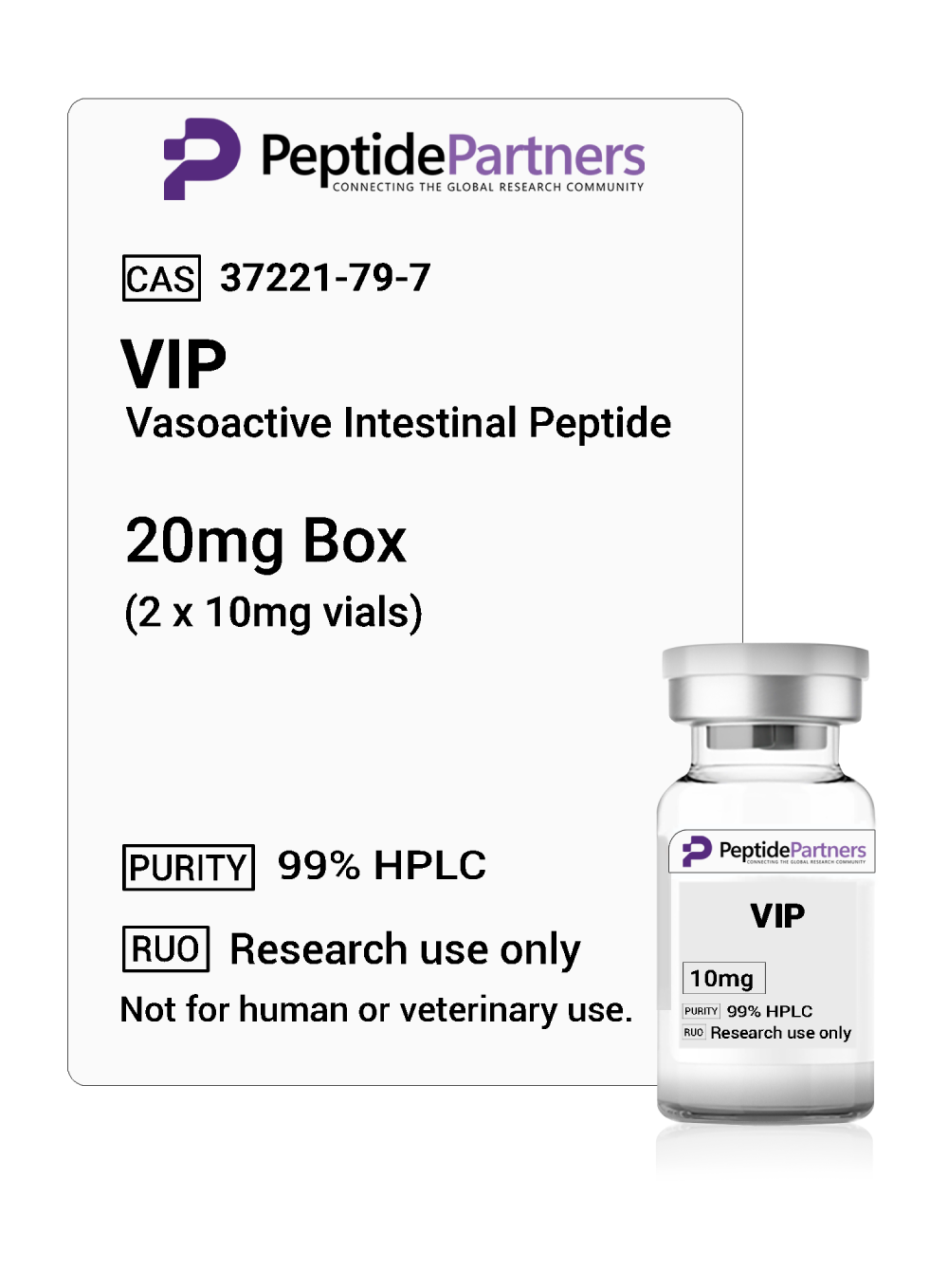
VIP (20mg – 200mg)
Price range: $136.00 through $900.00
Description
VIP
Vasoactive Intestinal Peptide
Independently Certified USP<85> Endotoxin Safe
Save over 60%!
Swipe right to view full table →
 |
Peptide Sciences | Core Peptides | |
Cost per milligram |
$4.50 – $6.80 |
$12.50 | $10.67 |
Purity |
99.42% |
98.1% | 99.1% |
Certified Endotoxin-safe |
Yes |
No | No |
Independently Tested |
Yes |
No | No |
Peptide Partners Manufacturer Id: SH07
Batch Id: VP20250511
Overview
(For educational purposes only)
Vasoactive Intestinal Peptide (VIP) represents one of the most versatile and extensively studied neuropeptides in mammalian physiology, with its influence extending far beyond its initial discovery as a vasodilatory agent in the intestine. This 28-amino acid peptide, first isolated from porcine duodenum in 1970 by Said and Mutt, has emerged as a critical regulatory molecule governing diverse biological processes including cardiovascular function, immune responses, neuronal activity, and metabolic homeostasis. Through its actions on specific G-protein-coupled receptors, VIP demonstrates remarkable therapeutic potential across multiple disease states, from autoimmune disorders and inflammatory conditions to neurodegenerative diseases and metabolic dysfunction.
Molecular Structure and Biochemical Properties
VIP is a highly conserved 28-amino acid peptide belonging to the glucagon/secretin superfamily, with the amino acid sequence His-Ser-Asp-Ala-Val-Phe-Thr-Asp-Asn-Tyr-Thr-Arg-Leu-Arg-Lys-Gln-Met-Ala-Val-Lys-Lys-Tyr-Leu-Asn-Ser-Ile-Leu-Asn[1][2]. The peptide has a molecular formula of C147H237N43O43S and a molecular weight of 3326.8 g/mol[3][2]. VIP’s remarkable evolutionary conservation across species, with at least 85% sequence similarity among mammals, underscores its fundamental biological importance[4].
Three-Dimensional Structure
Nuclear magnetic resonance studies have revealed that VIP adopts distinct conformations depending on its environment. In aqueous solution, most of the 28-amino acid sequence forms an α-helical structure (residues 7-28), with the exception of the N-terminal region (residues 1-5), which lacks defined structure[5]. When bound to membrane-mimicking environments, VIP demonstrates structural plasticity, with micelle-bound VIP-G displaying a curved α-helix where hydrophobic residues Phe6, Tyr10, Leu13, and Met17 form a hydrophobic patch at the concave face, facilitating membrane binding[6].
Biosynthesis and Processing
VIP is synthesized from a large precursor molecule, prepro-VIP, containing 170 amino acids located on chromosome 6q24[4]. The biosynthetic pathway involves multiple enzymatic steps: signal peptidase in the endoplasmic reticulum cleaves prepro-VIP to yield 149-amino acid pro-VIP, which is subsequently processed by prohormone convertases to VIP-GKR, then by carboxypeptidase B-like enzymes to VIP-G, and finally by peptidyl-glycine α-amidating monooxygenase to the biologically active C-terminally amidated VIP[7][4].
Notably, the VIP gene also encodes peptide histidine methionine (PHM) in humans or peptide histidine isoleucine (PHI) in other mammals, which share some biological activities with VIP[7].
Receptor Systems and Signaling Mechanisms
VIP exerts its diverse biological effects through interaction with specific G-protein-coupled receptors, primarily VPAC1 and VPAC2, both belonging to class B GPCRs[8][9].
Receptor Distribution and Characteristics
VPAC1 receptors are predominantly expressed in the lungs and T-lymphocytes, while VPAC2 receptors are mainly found in smooth muscle, mast cells, and the basal regions of lung mucosa[10]. Both receptors show high affinity for VIP and PACAP (pituitary adenylate cyclase-activating polypeptide), with PACAP sharing 68% sequence homology with VIP[8][7].
Signal Transduction Pathways
VPAC receptors are primarily coupled to Gαs proteins, leading to adenylate cyclase activation and cyclic adenosine monophosphate (cAMP) elevation[8][9]. Additionally, these receptors can couple to Gαq and Gαi proteins, activating inositol phosphate/calcium/protein kinase C pathways[11]. The differential expression and activation of VPAC1 versus VPAC2 receptors underlies the tissue-specific effects of VIP, with VPAC1 primarily mediating glucagon secretion and hepatic glucose production, while VPAC2 is more involved in insulin secretion and glucose tolerance improvement[8].
Physiological Functions and Distribution
VIP demonstrates an extraordinarily broad distribution throughout vertebrate tissues, reflecting its diverse physiological roles.
Central and Peripheral Nervous Systems
In the central nervous system, VIP-like immunoreactivity has been identified in the cerebral cortex, hypothalamus, amygdala, hippocampus, and striatum[12]. VIP functions as both a neurotransmitter and neuromodulator, with particularly important roles in:
- Circadian rhythm regulation: VIP neurons in the suprachiasmatic nuclei of the hypothalamus serve as master circadian pacemakers[13]
- Neuroprotection: VIP provides protection against excitotoxic damage, β-amyloid toxicity, and inflammation-induced neurodegeneration[14][11][15]
- Neuroendocrine regulation: VIP stimulates the release of prolactin, luteinizing hormone, and growth hormone from the pituitary gland[7][9]
Cardiovascular System
VIP serves as a potent cardiovascular regulator with multiple beneficial effects:
- Vasodilation: VIP acts as a potent vasodilator, causing coronary vasodilation and reducing pulmonary vascular resistance[1][9]
- Cardiac function: The peptide has positive inotropic and chronotropic effects, stimulating myocardial contractility[1][9]
- Blood pressure regulation: VIP lowers arterial blood pressure through direct vascular smooth muscle relaxation and endothelial nitric oxide release[12][4]
Gastrointestinal System
As originally discovered, VIP plays crucial roles in digestive system function:
- Smooth muscle relaxation: VIP induces relaxation of the lower esophageal sphincter, stomach, and gallbladder[1][12]
- Secretomotor functions: The peptide stimulates secretion of water and electrolytes, pancreatic bicarbonate, and bile while inhibiting gastric acid secretion[1][12]
- Motility regulation: VIP enhances gastrointestinal motility and serves as a neurotransmitter in the enteric nervous system[1][4]
Respiratory System
VIP serves as the primary inhibitory neurotransmitter in the airways:
- Bronchodilation: VIP causes potent relaxation of airway smooth muscle, making it a potential therapeutic target for asthma and COPD[16]
- Anti-inflammatory effects: The peptide inhibits inflammatory cell activation and mediator release in lung tissues[17][16]
- Mucus secretion regulation: VIP modulates mucus production and composition in respiratory epithelia[16]
Immunomodulatory Properties
One of VIP’s most significant biological functions involves its role as an endogenous immunomodulator with potent anti-inflammatory properties.
Innate Immune Regulation
VIP profoundly influences innate immune responses through multiple mechanisms:
- Macrophage deactivation: VIP inhibits macrophage activation and the production of pro-inflammatory cytokines including TNF-α, IL-1β, IL-6, and IL-12[9][18]
- Anti-inflammatory cytokine induction: The peptide stimulates production of anti-inflammatory mediators such as IL-4, IL-10, IL-13, and IGF-1[9][18]
- Mast cell regulation: VIP modulates mast cell degranulation and mediator release, contributing to its anti-allergic properties[4]
Adaptive Immune Modulation
VIP’s effects on adaptive immunity are particularly significant for autoimmune disease therapy:
- Th1/Th2 balance: VIP shifts the T helper cell balance toward Th2 responses while suppressing pathogenic Th1 and Th17 activities[18][19]
- Regulatory T cell induction: VIP promotes the expansion and function of CD4+CD25+FoxP3+ regulatory T cells, which are crucial for immune tolerance[18][19]
- B cell regulation: The peptide influences antibody production, generally reducing pathogenic IgG2a antibodies associated with Th1 responses[18]
Therapeutic Applications and Clinical Potential
VIP’s diverse physiological functions translate into significant therapeutic potential across multiple disease areas.
Autoimmune and Inflammatory Diseases
Extensive preclinical research has demonstrated VIP’s efficacy in various autoimmune disease models:
- Rheumatoid arthritis: VIP administration significantly reduces joint inflammation, cartilage destruction, and bone erosion in experimental arthritis models[18][19][20]
- Multiple sclerosis: In experimental autoimmune encephalomyelitis models, VIP delays disease onset, reduces severity, and promotes remission[18]
- Type 1 diabetes: VIP treatment prevents β-cell destruction and preserves insulin production in autoimmune diabetes models[18]
- Inflammatory bowel disease: The peptide shows protective effects in models of Crohn’s disease and ulcerative colitis[17][18]
Pulmonary Diseases
VIP’s natural role as a bronchodilator and anti-inflammatory agent makes it particularly promising for respiratory diseases:
- Primary pulmonary hypertension: Clinical studies have shown that VIP inhalation significantly reduces mean pulmonary artery pressure, increases cardiac output, and improves exercise capacity in patients with primary pulmonary hypertension[21]
- Asthma and COPD: VIP analogs are being developed as potential treatments for chronic inflammatory lung diseases, with improved stability and delivery systems[16]
- Acute respiratory distress syndrome: The synthetic VIP formulation Aviptadil has shown promise in treating ARDS, including COVID-19-related cases[10]
Neurological Disorders
VIP’s neuroprotective properties offer potential therapeutic applications in neurodegenerative diseases:
- Parkinson’s disease: VIP treatment significantly reduces dopaminergic neuronal loss in MPTP-induced Parkinson’s models by blocking microglial activation[14]
- Alzheimer’s disease: Lipophilic VIP derivatives demonstrate protection against β-amyloid toxicity and cognitive improvement in animal models[15]
- Neonatal brain injury: VIP provides neuroprotection against excitotoxic white matter damage in developing brains[11]
- Migraine: Clinical studies have shown that VIP infusion can trigger migraine attacks, suggesting its involvement in migraine pathophysiology and potential as a therapeutic target[22]
Metabolic Disorders
Recent research has highlighted VIP’s role in metabolic regulation:
- Type 2 diabetes: VIP stimulates glucose-dependent insulin secretion, particularly through VPAC2 receptor activation, making VPAC2-selective agonists promising diabetes therapeutics[8][23]
- Obesity: VIP influences satiety and energy homeostasis through hypothalamic pathways[8]
Pharmacokinetic Challenges and Drug Development
Despite its therapeutic promise, VIP faces significant challenges for clinical application due to its inherent instability and pharmacokinetic limitations.
Stability and Half-Life Issues
VIP has an extremely short plasma half-life of approximately 2 minutes, severely limiting its therapeutic utility[1]. This rapid degradation results from:
- Enzymatic cleavage: VIP is highly susceptible to peptidases present in most tissues[18]
- Structural instability: The natural peptide structure is prone to degradation under physiological conditions[24]
Drug Development Strategies
Multiple approaches are being pursued to overcome VIP’s pharmacokinetic limitations:
- Structural modifications: Development of stable analogs through amino acid substitutions, cyclization, or chemical modifications[18][16]
- Lipophilic derivatives: Attachment of lipophilic moieties (such as stearyl groups) dramatically improves potency and brain penetration[15]
- Nanoparticle delivery: VIP-containing nanoparticles protect against degradation while enabling targeted delivery[17][18]
- Gene therapy approaches: VIP gene transfer using viral vectors shows promise in some experimental models[17]
- Selective receptor agonists: Development of VPAC2-selective agonists offers improved specificity and reduced side effects[8][23]
Current Clinical Status and Future Directions
Approved Therapeutic Applications
While VIP itself is not widely approved for clinical use, its synthetic analog Aviptadil has received attention for treating acute respiratory distress syndrome and has been investigated for COVID-19 treatment[10]. VIP has also been tested in clinical trials for primary pulmonary hypertension with promising results[21].
Ongoing Research and Development
Current research focuses on several key areas:
- Biomarker applications: VIP levels are being investigated as biomarkers for various inflammatory and autoimmune diseases[25][26]
- Precision medicine approaches: Understanding individual variations in VIP receptor expression may enable personalized treatment strategies[25]
- Combination therapies: VIP is being studied in combination with other therapeutics to enhance efficacy while minimizing side effects[17]
- Novel delivery systems: Advanced drug delivery technologies are being developed to improve VIP’s stability and bioavailability[17][16]
Safety Profile and Considerations
Clinical studies have generally demonstrated VIP’s good safety profile when administered appropriately:
- Tolerability: VIP has been well-tolerated in human studies for sepsis and other conditions, with no significant side effects such as excessive vasodilation or hormonal imbalances[18]
- Dose-dependent effects: The therapeutic window appears to be favorable, with beneficial effects achievable at doses that do not cause significant adverse effects[21]
- Route-dependent safety: Inhalation routes appear particularly safe, avoiding systemic vasodilatory effects while achieving local therapeutic benefits[21][16]
Conclusion
Vasoactive Intestinal Peptide stands as a remarkable example of biological versatility, functioning as a neurotransmitter, hormone, and immunomodulator across multiple physiological systems. Its discovery over five decades ago has led to an extensive understanding of its roles in cardiovascular regulation, immune homeostasis, neuroprotection, and metabolic control. The peptide’s therapeutic potential spans an impressive range of diseases, from autoimmune disorders and inflammatory conditions to neurodegenerative diseases and metabolic dysfunction.
The primary challenges facing VIP’s clinical translation—namely its short half-life and susceptibility to degradation—are being actively addressed through innovative drug development strategies including structural modifications, targeted delivery systems, and selective receptor agonists. The success of these approaches, combined with growing understanding of VIP’s mechanisms and the development of personalized medicine strategies, positions this neuropeptide as a promising therapeutic agent for the future.
As research continues to unveil new aspects of VIP biology and overcome its pharmacokinetic limitations, this versatile peptide may finally realize its full therapeutic potential, offering new hope for patients suffering from a wide range of inflammatory, autoimmune, and neurodegenerative conditions. The breadth of VIP’s biological activities, combined with its generally favorable safety profile, makes it an attractive candidate for addressing some of medicine’s most challenging diseases through targeted, mechanism-based interventions.
⁂
- 1. https://en.wikipedia.org/wiki/Vasoactive_intestinal_peptide
- 2. https://pubchem.ncbi.nlm.nih.gov/compound/Vasoactive-intestinal-peptide
- 3. https://www.chemicalbook.com/ChemicalProductProperty_EN_CB21343014.htm
- 4. https://pmc.ncbi.nlm.nih.gov/articles/PMC6743256/
- 5. https://pmc.ncbi.nlm.nih.gov/articles/PMC3499705/
- 6. https://www.rcsb.org/structure/2RRH
- 7. https://www.bachem.com/knowledge-center/white-papers/vip-pacap-peptides/
- 8. https://www.frontiersin.org/journals/endocrinology/articles/10.3389/fendo.2022.984198/full
- 9. https://jbiomedsci.biomedcentral.com/articles/10.1186/s12929-016-0280-1
- 10. https://en.wikipedia.org/wiki/Aviptadil
- 11. https://pmc.ncbi.nlm.nih.gov/articles/PMC3370262/
- 12. https://www.sciencedirect.com/topics/neuroscience/vasoactive-intestinal-peptide
- 13. https://www.frontiersin.org/journals/endocrinology/articles/10.3389/fendo.2012.00129/full
- 14. https://pubmed.ncbi.nlm.nih.gov/12626429/
- 15. https://www.pnas.org/doi/10.1073/pnas.96.7.4143
- 16. https://www.sciencedirect.com/science/article/pii/S0196978107001295
- 17. https://f1000research.com/articles/8-1629
- 18. https://pmc.ncbi.nlm.nih.gov/articles/PMC2095290/
- 19. https://www.frontiersin.org/journals/immunology/articles/10.3389/fimmu.2021.701862/full
- 20. https://pmc.ncbi.nlm.nih.gov/articles/PMC6092975/
- 21. https://pmc.ncbi.nlm.nih.gov/articles/PMC154449/
- 22. https://jamanetwork.com/journals/jamanetworkopen/fullarticle/2782759
- 23. https://pubmed.ncbi.nlm.nih.gov/36204104/
- 24. https://link.springer.com/article/10.1007/s00210-007-0232-0
- 25. https://pubmed.ncbi.nlm.nih.gov/31861827/
- 26. https://www.nature.com/articles/s41598-020-70138-3
Additional information
| Quantity (mg) | 20, 50, 100, 200 |
|---|

Reviews
There are no reviews yet.